Instagram Appeal Denied? 5 Routes That Still Recover Accounts
Most creators stop at the rejection and lose the account. The Meta Verified route, GDPR Article 22, the Oversight Board pilot, and the press play — with cases that worked.
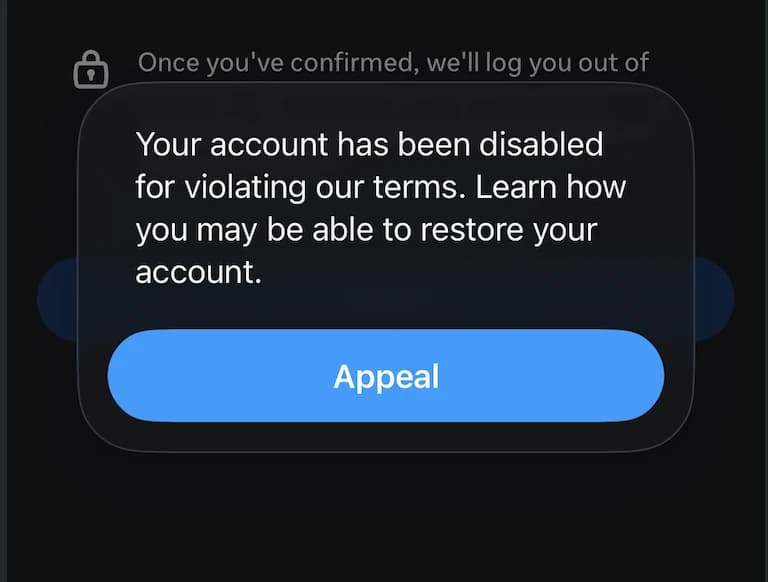
You did the right thing. You screenshotted the disabled-account screen. You wrote a calm, specific appeal. You uploaded the ID. You waited.
And then, sometime between four hours and four days later, the notification came: “We've reviewed your account and we won't restore it.” No specifics. No example post. No second chance from the same form.
Most creators stop here. They assume the door closed and start over from zero. That instinct is wrong — not because the standard appeal will magically come back, but because there are at least five other doors that sometimes open in 2026. None of them is a guarantee. A few of them barely existed two years ago. All of them are worth knowing before you give up on an account you spent years building.
This is the field manual for what to actually try after your Instagram appeal gets denied in 2026, based on real cases from the last twelve months — the BBC's reporting on the wrongful-ban wave, the TechCrunch coverage that finally got Meta to respond, the Reddit and Blind threads where the workarounds were born, and the Oversight Board's newly-announced pilot for account-level reviews.
Step 1: Know which ban you're actually in
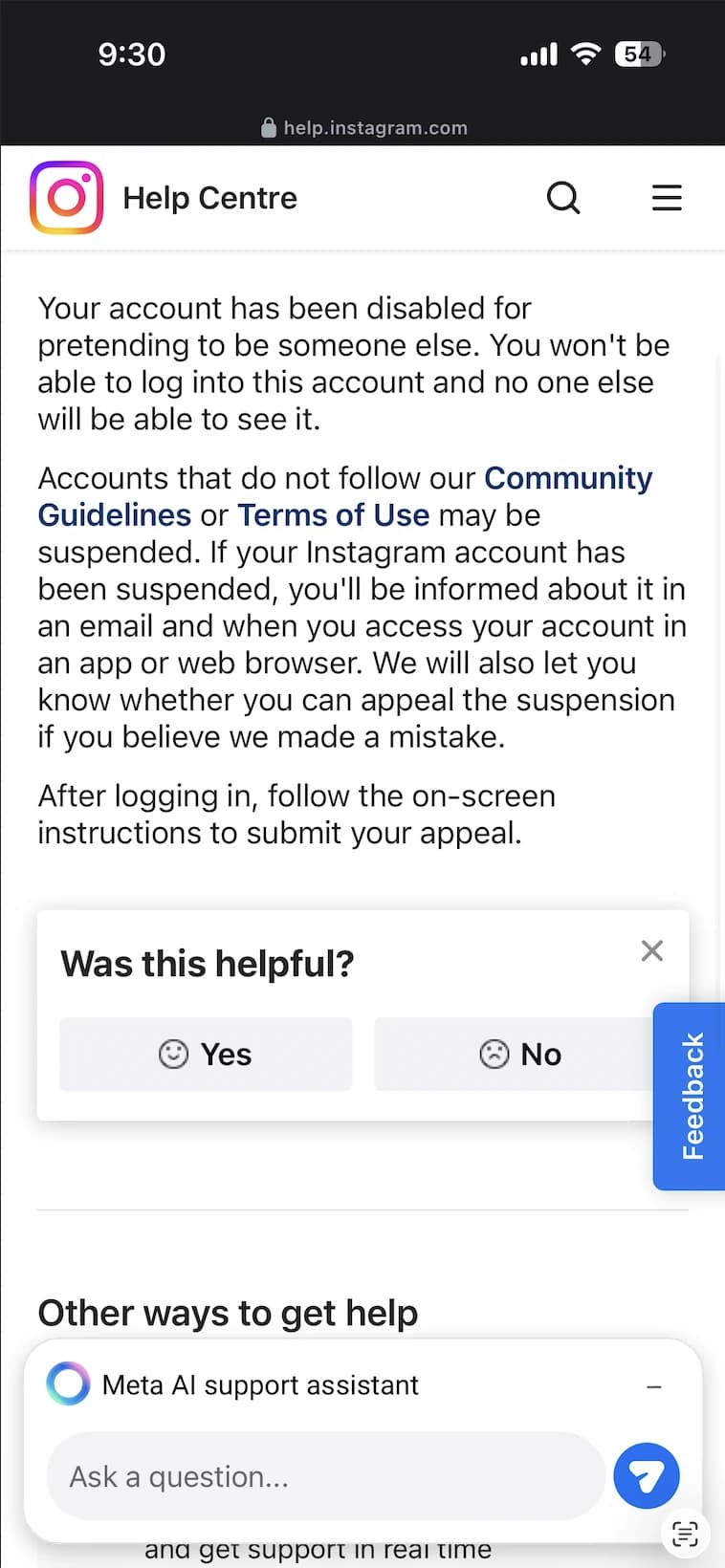
Every recovery path that follows depends on which category of ban Meta's system put you in. The wrong path won't just fail — it can flag your case as bad-faith and shut other paths down. Five categories cover almost everything you'll see in 2026:
- The CSE auto-flag. An AI classifier flagged your content as child-safety-related — a beach photo of your own kid, a swimwear product shot, an old gymnastics meet clip. Almost always wrong, almost always denied on first appeal. The BBC documented hundreds of these in 2025 and they have continued in waves through 2026.
- The carpet ban. Your account was clean, but a different account — one Meta linked to your device, IP, phone number, or recovery email — was previously banned. Sometimes it's an account a friend logged into on your phone years ago. Sometimes it's a backup you forgot about. Recovery is hardest here because the connection itself is treated as the violation.
- The DMCA chain. Three or more copyright strikes in quick succession auto-disable the account. Even when complaints are later retracted, Meta often leaves the account disabled. The BBB complaint pattern for Meta is full of these.
- Hacked-then-policy. An attacker logged in, posted violating content, then the account got auto-banned for that content. You appeal, Meta sees the violation in the logs and denies. This is the category most likely to get reversed — but only through the hacked-account form, not the standard appeal.
- The vague “Community Guidelines” ban. No specifics, no example, just “your account doesn't follow our policies.” This is the most ambiguous category and also the one where Meta Verified support, public pressure, and GDPR Article 22 have the highest hit rate.
Within each, there's a sub-status that matters: suspended or disabled usually means “under review” and you can still log in. Permanently disabled means you can't log in at all, and your account is on a path to deletion (usually 30 days out). Every recovery method below works better while you're still in the first state. Once you're in the second, you have days, not weeks, before your username, content, and DM history are gone for good.
A quick note on the “Great Purge of 2026”
Creators searching for help on the “great purge” are usually conflating two very different events. The May 2026 bot purge was a six-hour sweep that wiped fake and dormant followers from legitimate accounts — Kylie Jenner lost 14 million, Instagram's own account lost millions. Real creator accounts were not banned; they just lost ghost followers.
The event you almost certainly mean is the 2025 AI mass-suspension wave — the one that hit ~635,000 accounts in July 2025 alone and has continued through 2026 as Meta's CSE classifier rolls out in new regions. That wave produced the 50,000-signature petition and the BBC's reporting. If your account was wiped with no explanation in 2025 or 2026 and the appeal failed instantly, this is the bucket you're in — and the recovery paths below apply.
Step 2: The Meta Verified badge play
This is the option creators ask about first, because the marketing copy promises “account support.” Be very clear-eyed about it. Meta Verified is a strong preventive moat — a subscribed account is meaningfully less likely to get caught in an AI sweep in the first place. It is a much weaker rescue tool once a ban has already happened. The TechCrunch coverage and the petition include hundreds of subscribers who paid $14.99 a month and got the same template denials as free users.
That said, there is a real workaround creators have used. It only helps a narrow slice of bans — ambiguous “Community Guidelines” cases, mostly — but when it works, it's the cheapest live-human channel into Meta you'll find.
What it costs
As of June 2026, Meta Verified for individuals is $11.99/mo on the web and $14.99/mo through the iOS or Android app (Apple and Google take roughly a 30% cut on in-app subscriptions, which is why the web price is lower). UK pricing is £9.99/£11.99, India is ₹599/₹699, with most of LATAM and the EU live as well. Business tiers run from $14.99/mo to $499.99/mo and add “priority” support — useful for agency accounts with serious ad spend, not for solo creators. Confirm at checkout; Meta cycles intro pricing quietly. See the official Meta Verified page for current rates in your region.
Can a banned account subscribe?
No. This is the most important thing to know. Once your account is disabled, you can't complete the Meta Verified flow on it because you can't log in, post, or pass the in-app ID check. Eligibility requires being 18+, having posting history, having 2FA enabled, and showing no active strikes — all of which a banned account fails by definition.
The “subscribe on a new account” workaround
Here's the play creators have been documenting on Reddit and Blind since 2024:
- Create a new Instagram account on a clean device — different phone if possible, definitely a different browser and a different recovery email. Post a few real things over a few days so it has a footprint. Enable 2FA.
- Subscribe to Meta Verified on this new account, via the web for the cheaper price. Pass the ID check (the ID must match the name on the new account, not the banned one).
- Open the Meta Verified live chat from Settings → Meta Verified → Get Support. Calmly ask the agent to look up your disabled account by email, phone number, or username. Have screenshots, your ID, and a one-paragraph explanation of what happened ready to paste.
- Expect to open three to five chat sessions before you hit an agent willing to escalate. Agents at this tier rotate; some can attach a note that triggers a human re-review, others can't. This is the part that requires patience.
- If the old account is restored, cancel before the next billing cycle. If it isn't, expect to keep the sub for at least one full month, because escalations take days.
Meta does not document or endorse this workflow. It works because the support chat exists and the agents have the technical ability to look up your other accounts — not because there's a formal policy to help banned subscribers. The honest hit rate, based on the cases I've seen, is somewhere between 10% and 25% for ambiguous Community Guidelines bans, and effectively 0% for CSE, copyright, terror, or hacked-and-used-for-spam bans. If your appeal denial mentioned any of those, save the $14.99 and skip this step.
And know the limits: Meta does not refund the subscription because support didn't fix your account. The EU/UK 14-day cooling-off window applies to first subscriptions; after that, you're paying whether the account comes back or not.
Step 3: The hacked-account form — only if you were actually hacked
If your account was genuinely compromised — an attacker changed the email, the phone number, the password, or posted violating content before the ban — do not use the regular appeal flow. Use the dedicated hacked-account form at help.instagram.com/contact/740949042640030.
This routes to a different team than the standard appeal. Instead of reviewing your content for policy violations, they run an identity verification (selfie video, government ID, sometimes a few security questions about your account history) and restore the account if you can prove you're the original owner. This works in cases the standard appeal won't touch — including hacked-then-policy-banned accounts — because the team treats the policy violation as the attacker's, not yours.
The hard rule: only use this if you were actually hacked. Filing a hacked-account claim for a policy strike will get bounced and may flag your case as bad-faith, which makes every other recovery path harder. If you're not sure whether you were hacked, check your login activity (you can sometimes see this in the original login notification emails Instagram sent before the ban) and your recovery-email change history.
Step 4: The press and public-pressure play
This sounds petty until you read the BBC piece. Meta restored dozens of wrongfully-banned accounts in 2025 not because the appeal system worked, but because journalists asked Meta's press team about specific cases by name. The BBC noted Meta “frequently overturned bans when the BBC raised individual cases” — cases that had already been denied through every official channel.
This is the most uncomfortable lever in the playbook because it depends on either having reach or generating attention. But it works, and 2026 creators who've done it have three reliable playbooks:
- The X post tagging @mosseri. Instagram's head Adam Mosseri is unusually responsive to public complaints when they include screenshots, a clear narrative, and obvious unfairness. He does not respond to most. He responds to enough that journalists have learned to monitor his replies. If your case is provably wrongful and visually clear (the BBC's family-photo case worked because it was instantly sympathetic), this is the cheapest first move.
- The cold journalist email. Reporters at the BBC, TechCrunch, 404Media, The Verge, and Wired have all covered the 2025–26 wrongful-ban wave. They want pattern stories. Pitch yours in 100 words: who you are, what happened, what Meta said, the proof you have, and one sentence on why it matters (revenue, audience, public service). Most pitches get ignored; the ones that land tend to land hard.
- The petition / Change.org route. The Hold Meta Accountable petition passed 50,000 signatures and is still the most visible organizing surface for affected creators. Adding your case doesn't recover you directly, but it adds to the pressure journalists cite and gives you a public record of what happened.
Be honest with yourself about whether your case is sympathetic. Press coverage works on cases with a clear, visual, instantly-explainable injustice. A spam-classifier hit on an engagement-heavy DM flow is not that. A grandmother banned for posting her grandkid's birthday is.
Step 5: EU and UK creators — GDPR Article 22
If you're an EU or UK resident, you have a legal lever no American or Indian creator can use, and Meta now treats it seriously because of the Irish DPC's €405M fine and continued oversight: GDPR Article 22 grants you the right to demand human review of any decision made solely by automated systems. A 2026 AI ban is exactly that.
The mechanics:
- Send a Data Subject Access Request (DSAR) to Meta. Use the form at help.instagram.com or email [email protected]. Ask for all data, logs, and reasoning related to the disabling of your account. Meta has 30 days to respond.
- Cite Article 22 explicitly and request human review of the automated decision. State you do not consent to a solely-automated decision affecting your business and audience.
- If they refuse or stall, file with your data protection authority. For Meta, that's the Irish Data Protection Commission. Their complaint form takes 15 minutes; their case files are public; Meta tracks them.
- Send Meta a follow-up referencing the DPC complaint number. This is the single line that has been moving cases off the templated-denial queue in 2025–26.
It's slow. It takes weeks, sometimes months. But unlike Meta Verified, it doesn't cost anything, and unlike the press play, it doesn't depend on you being sympathetic — just being right.
Step 6: The Oversight Board pilot (new for June 2026)
For most of its existence, Meta's Oversight Board only handled appeals about specific posts — not account-level bans. That changed in early June 2026, when the Board publicly criticized Meta's account-ban process and announced a pilot to review account-level disables.
Two things to know before you pin hopes here. First, the pilot is new. There's no public submission flow yet for account-level cases, and the Board is selecting cases that demonstrate systemic issues, not individual restorations. Second, the Board can only review cases where the user could still file something — which currently means you need to be able to log in to start the appeal. Permanent-disabled accounts can't.
What to do today: watch oversightboard.com for the pilot's public submission window when it opens, and if your case is part of an obvious systemic pattern (CSE-flag wave, carpet ban from a years-old linked account, a banned creator category like medical or cannabis education), it's the strongest case-selection signal you have. The Board's rulings are binding on Meta, which is more than any other recourse on this list can claim.
Step 7: Last resorts — BBB, FTC, small claims
Three more levers worth knowing, ranked from cheapest to most serious. None has a great hit rate; all of them have moved at least some cases.
- BBB complaint. Meta's BBB profile shows hundreds of account-disable complaints. The resolution rate is low, but there are documented cases of Meta restoring accounts when a BBB complaint included revenue-loss evidence. It costs nothing and takes ten minutes.
- FTC complaint (US only). No documented direct restorations — but pattern complaints have influenced enforcement actions against Meta historically. File it as documentation and pressure, not as a recovery path.
- Small claims court. In the US, you can file in San Mateo County (Meta's home county). Filing fees run $30 to $75 depending on the claim amount. Meta sometimes settles before the hearing date by restoring the account — not because they admit fault, but because it's cheaper than showing up. The cap on small-claims awards is $10,000 in California, which is plenty for any documented business loss. This is the path Blind users in tech consistently call the single most reliable recovery method when Meta Verified fails. It's also the most work.
Step 8: Knowing when it's actually over
You've worked through every door. The Meta Verified chat went nowhere, the hacked form didn't apply, the press didn't bite, the DPC complaint sits in queue, the Oversight Board hasn't opened the pilot. The account moves from “disabled” to “permanently disabled.” The data-export window passes. It's over.
This is the moment where most creators make their second mistake. They spin up a new account on the same phone, with the same email, and start posting within a week. The same fingerprint that got carpet-banned brings the new account down inside a month. Then they try again. Then they give up.
If you have to rebuild, rebuild properly:
- New device, or at minimum factory-reset the old one. Meta's device fingerprinting is sophisticated. A clean phone is the single biggest fingerprint reset you can give yourself.
- New SIM, new phone number. Phone number is the stickiest identifier Meta uses to link accounts. A prepaid SIM from a different carrier costs less than $20 and breaks the link.
- New recovery email on a different provider. Not a Gmail alias, not a plus-tag, a different mailbox on a different domain.
- Different IP for the first weeks. Mobile data on the new SIM is enough — just don't log in from the home Wi-Fi the banned account used for years.
- Slow ramp. Post a few real things over a few weeks before any DMs, any automations, any aggressive growth plays. The classifier watches new accounts more carefully for the first 30 days.
And then — this is the part most creators learn too late — do not rebuild on Instagram alone. The single most important lesson from the 2025–26 ban wave is that an Instagram audience is rented, not owned. The creators who lost their accounts and survived had email lists, SMS lists, bio-link pages with their own URL, and DM funnels that captured leads off the platform. The creators who lost their accounts and lost everything had only Instagram followers.
That's the thing worth taking from this article even if you get your account back: own the relationship. Run a bio link page with your own URL. Capture emails on every lead-magnet DM. Build a list you can take with you when, not if, the next ban wave catches your account too.
Free tool · No signup
● NewWrite the appeal for you — calm, factual, reviewer-ready
Fill in the [brackets] before you submit. One appeal only.
Where this leaves Creator Lane
Creator Lane was built around exactly this lesson. Every comment-to-DM funnel inside it captures the commenter's Instagram handle. Every lead-magnet flow can ask for an email directly inside the DM. The bio-link page lives on your own URL, not Instagram's. The whole point is that if your IG account goes down tomorrow, the audience you built doesn't go down with it — because you have their email, their phone, and a list of every commenter who ever engaged.
We also run only on Meta's official Graph API as a registered Tech Provider. No scraping, no fake-engagement, no password-based login. The tool itself isn't the thing that puts your account at risk. That doesn't make you immune to the AI sweep, but it does mean you can stop worrying about one ban category. Start Creator Lane free if you're ready to build something a future ban can't take from you.
Related reading: the first-hour ban recovery playbook, what to do about a false CSE flag, India's Grievance Officer + GAC route, the recovery-services scam checklist, how to check and fix a 2026 shadowban, and the legal DM-automation guide for the long-term version of all of this.