Complete Carbs Guide
Inside this guide
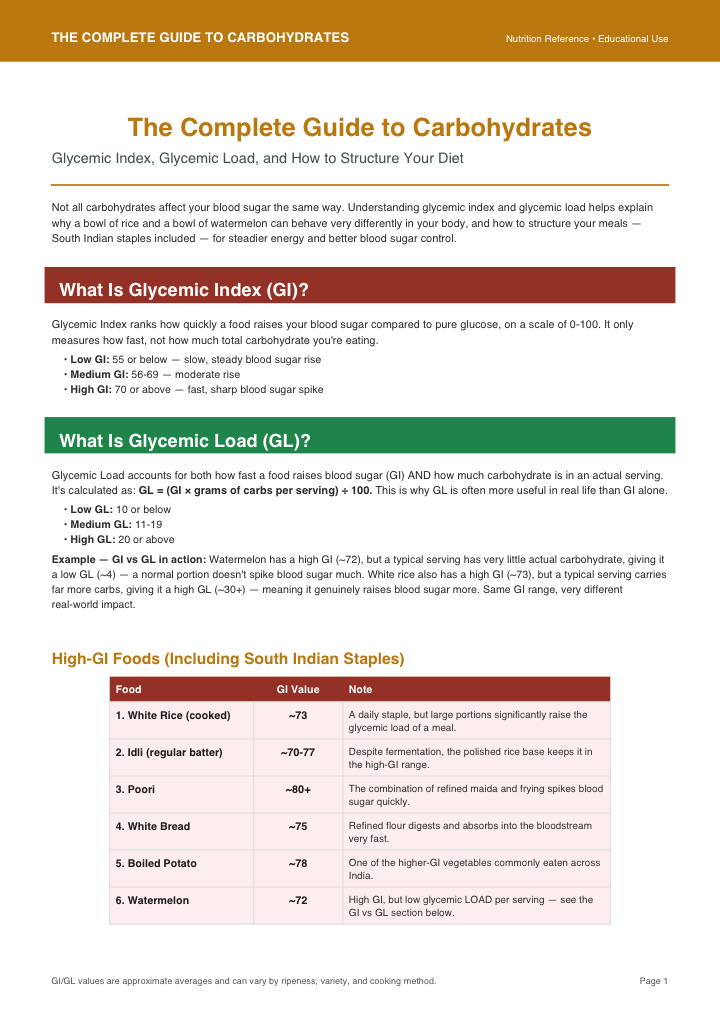
THE COMPLETE GUIDE TO CARBOHYDRATES Nutrition Reference Educational Use GI/GL values are approximate averages and can vary by ripeness, variety, and cooking method. Page 1 The Complete Guide to Carbohydrates Glycemic Index, Glycemic Load, and How to Structure Your Diet Not all carbohydrates affect your blood sugar the same way. Understanding glycemic index and glycemic load helps explain why a bowl of rice and a bowl of watermelon can behave very differently in your body, and how to structure your meals — South Indian staples included — for steadier energy and better blood sugar control. What Is Glycemic Index (GI)? Glycemic Index ranks how quickly a food raises your blood sugar compared to pure glucose, on a scale of 0-100. It only measures how fast, not how much total carbohydrate you're eating. Low GI: 55 or below — slow, steady blood sugar rise Medium GI: 56-69 — moderate rise High GI: 70 or above — fast, sharp blood sugar spike What Is Glycemic Load (GL)? Glycemic Load accounts for both how fast a food raises blood sugar (GI) AND how much carbohydrate is in an actual serving. It's calculated as: GL = (GI × grams of carbs per serving) ÷ 100. This is why GL is often more useful in real life than GI alone. Low GL: 10 or below Medium GL: 11-19 High GL: 20 or above Example — GI vs GL in action: Watermelon has a high GI (~72), but a typical serving has very little actual carbohydrate, giving it a low GL (~4) — a normal portion doesn't spike blood sugar much. White rice also has a high GI (~73), but a typical serving carries far more carbs, giving it a high GL (~30+) — meaning it genuinely raises blood sugar more. Same GI range, very different real-world impact. High-GI Foods (Including South Indian Staples) Food GI Value Note 1.…